

6-3-4™ Changes Explained
By Kyle Richardville, Understanding Ag, LLC
If you've spent any time in an Understanding Ag workshop, webinar, or consultation, you've heard us talk about the 6-3-4™: the Six Principles of Soil Health, the Three Rules of Adaptive Stewardship, and the Four Ecosystem Processes. It's the framework that informs every recommendation, and it has held up remarkably well across cropland, rangeland, and everything in between.
But frameworks, like the land they describe, benefit from the occasional disruption. After years of teaching the 6-3-4™ to farmers and ranchers around the world, we realized we had a word doing too many jobs at once: diversity.
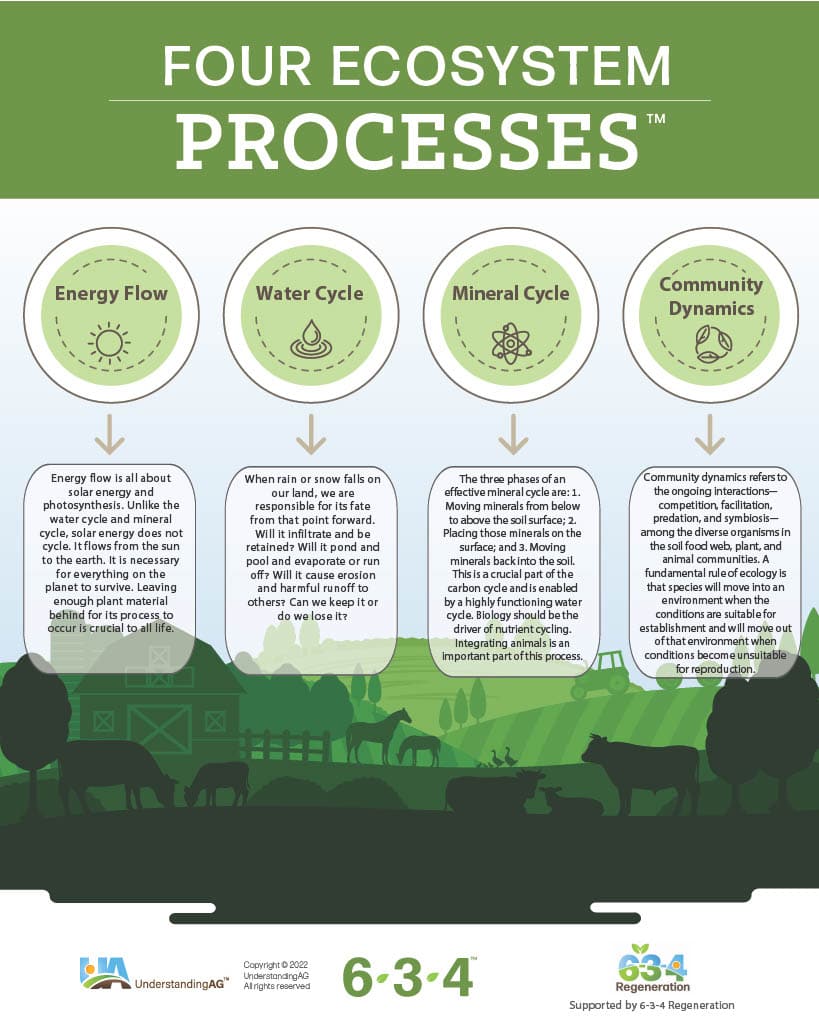
Diversity showed up as a Principle of Soil Health, a Rule of Adaptive Stewardship, and an Ecosystem Process. So we made a change. Diversity remains one of the Six Principles, right where it belongs. But in the Three Rules, diversity is now Integration. And in the Four Ecosystem Processes, diversity is now Community Dynamics.


A Rule Should Tell You What to Do
Here's the thing about a rule: it needs to describe an action, something you can actually do. Compounding and Disruption pass that test easily. Compounding is about noticing the cascading effects, good and bad, of every management decision, and nudging them in the “good” direction. Disruption is about deliberately varying your practices so the land, the livestock, and the microbial community never settle into complacency.
Diversity never quite fit that mold. Diversity is what happens when your management is working, not the practice itself. You don't manage diversity directly any more than a farmer manages "yield." You manage the practices that produce it. That distinction gets a little blurry on the cropping side, where you're intentionally selecting a diverse seed mix for a cover crop blend, so it can feel like an action. But even there, the mix itself is a tool for something else: getting more species, functions, and life forms interacting in the same space and time. That "something else" is what we now call Integration.
Integration is the deliberate combining of diverse plants, animals, and enterprises so their relationships strengthen all of the ecosystem processes at once, rather than just existing side by side. Think of cover crop species planted together instead of in isolation, multi-species grazing where cattle, sheep, and poultry follow one another across the same ground, or crop-livestock reintegration that puts animals back onto row-crop acres after decades of separation. In each case, you're getting those parts to interact so the whole system functions better than the sum of what any single species or enterprise could do alone.

That's the piece that makes Integration a true rule and not just a rebranded principle. It's a lever you can reach for on purpose, and pulling it doesn't just boost diversity for its own sake, it strengthens the water cycle, the mineral cycle, energy flow, and community dynamics all at the same time. That makes it pair naturally with Compounding and Disruption, because integrating a new species or enterprise into your operation is itself a disruption, and the effects of that disruption compound over time.
An Ecosystem Process Should Describe How Nature Works
The Four Ecosystem Processes are a different matter altogether. Energy Flow, the Water Cycle, and the Mineral Cycle all describe a mechanism, something nature is doing behind the scenes whether we're paying attention or not. Diversity never described a mechanism. Rather, it described an outcome.
Biological succession and community dynamics are the actual processes at work here. As microbial populations shift, the ecosystem begins to change. Plant communities mature from early colonizers to more complex stands, followed by insects, birds, and wildlife. The ecosystem is doing something, not just accumulating a longer species list. That process, the constant turnover and interplay among organisms responding to management and to each other, is what community dynamics captures. Increased diversity is the natural outcome of community dynamics unfolding over time, not the process itself.
Same Land, Sharper Language
None of this changes how you should be running your operation. If you've been layering species, stacking enterprises, and building disruption into your grazing or cropping plan, you've been practicing Integration all along, and Community Dynamics have been shifting in response. The 6-3-4™ still points to the same soil, the same principles, and the same outcomes it always has.
If you’re ready to better understand what’s happening on your land, we can help. Reach out to schedule a conversation with one of our consultants, or join us at an upcoming workshop to learn how these principles can be put into practice on your operation
